Gaunt's videotape
Needful ThingsLeland Gaunt’s videotape is both a piece of evidence and a calculated lure: left for Alan Pangborn in Needful Things, it shows that Ace Merrill deliberately caused the crash that killed Alan’s wife, Annie, and younger son, Todd. Its arrival converts Alan’s private grief into a possible mission of revenge, making the cassette an instrument in Gaunt’s larger manipulation as well as a record of a hidden crime.
Discovery and the message
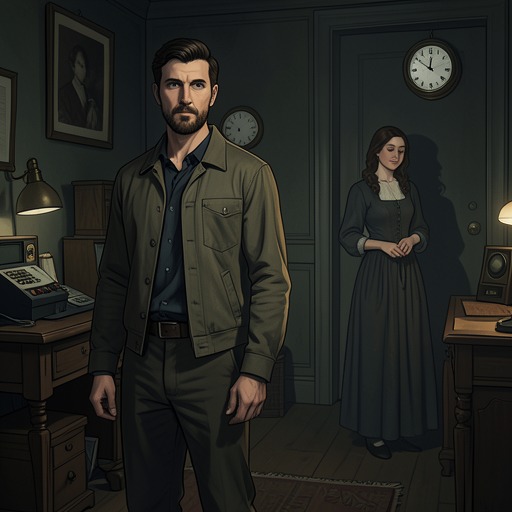
The videotape waits in a dusty display area beside a red Sony portable television and a VCR. The television’s cord is not a power lead but a short length of coaxial cable, and the cassette itself is hidden in an unmarked black plastic case on top of the VCR. Nearby, Gaunt has left a white business envelope addressed to Sheriff Alan Pangborn. The equipment looks like an ordinary abandoned entertainment setup, but its dust and disconnected plug underline that the cassette has been deliberately placed rather than left ready to play.
Gaunt’s letter frames the tape as a transaction. He says he has left something Alan will find interesting, insists it is not a gift, and invokes the town’s belief that Alan is honorable: the sheriff, Gaunt implies, will pay the price he asks. That price includes a service Gaunt presents as more good deed than prank. He promises that Alan’s questions about the last moments of Annie and Todd’s lives will soon be answered. The wording makes the promised revelation inseparable from obligation: the tape is offered not as comfort, but as leverage.
Alan’s hesitation and the recording
The cassette’s subject carries particular force because Alan had once made home movies of his family. He remembers filming his children as they grew up, Annie bathing them, birthdays, and family outings; later, he switched to video because it was cheaper and easier. Against that history, the unlabelled cassette is not just a mysterious object. It belongs to a familiar medium through which Alan once preserved ordinary family life, now repurposed to expose its violent end.
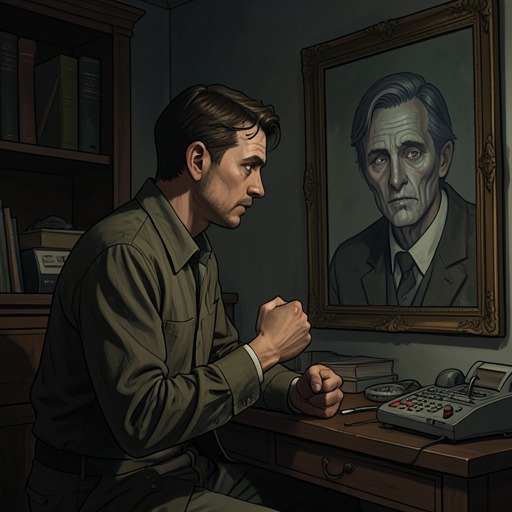
When Alan takes the cassette out of its case, his hand pauses over the VCR’s power button. The image of Todd, Sean, and Annie that occupies his thoughts gives way to the shocked face of Brian Rusk, whom Alan had seen earlier that day. Brian’s warning returns to him, but Alan proceeds. He turns on the red Sony, ejects the cassette carrier, loads the tape, and presses play. After the screen’s white static, blackness, and a brief countdown, the recording opens on a shaky handheld view of a country road.
The crash revealed
Alan recognizes the road as Route 117, including the curve and the pine grove where the Scout had crashed. The trees in the recording are unscarred, unlike the trees he has visited many times since the accident. Their unwounded surfaces tell him that the footage comes from the day Annie and Todd died. The tape’s view of the landscape thus supplies a temporal clue before it supplies an explanation: it is not merely showing the crash site, but showing it before the crash left its mark.
A lime-green Dodge Challenger follows the Scout. Alan recognizes the car and understands who is driving it: Ace Merrill. The recording then gives him a brief, unbearable view inside the Scout. Annie wears the paisley scarf she had tied in her hair that day; Todd wears his Star Trek T-shirt and looks back toward the pursuing car, while Annie leans forward, her shoulder harness pulled taut. Alan watches the last images of his wife and son, aware that seeing them cannot change what happened.
The Challenger bumps the Scout. Although the impact is not hard, Annie has sped up, and the contact is enough to send the Scout off course. It misses the curve, veers toward the grove, jolts through the ditch, and strikes the large pine. Annie is thrown through the windshield. The silent recording makes the cause of the crash plain: Ace’s car did not merely happen to be nearby; the bump sends the Scout toward the trees.
Evidence, temptation, and consequence
The tape changes Alan’s understanding of the deaths by revealing a deliberate act behind what he had been unable to explain. Gaunt has anticipated both the questions that keep Alan bound to the accident and the emotional power of seeing its final moments. The footage answers Alan’s uncertainty, but it does so in the form of a replay that makes him witness the loss again before directing his attention toward the man responsible.
The object’s practical function and its emotional force are inseparable. A VCR, a cassette, and a portable television make the past mechanically replayable; the device does not restore Annie and Todd, but returns their last moments to Alan as images. The ordinary equipment becomes conspicuous precisely because it has been arranged to make a private catastrophe visible. By giving Alan evidence and at the same time exposing him to a renewed encounter with the deaths, Gaunt’s videotape turns remembrance into a means of control—and the revelation into a dangerous invitation to revenge.